I’m from Darlington, a big railway town – back in those days, anyone who lived there moved into that business. I didn’t want to do that – I wanted to be a poster artist. The only thing I could think of that seemed akin to that sort of thing was printing, so I left school at 14 to start an apprenticeship as a type compositor. My grandfather had been a sign writer back in the days when everything had to be done by hand, so perhaps it ran in the family.
I never thought I’d go to college but by luck and good fortune I finished up at Watford College of Technology. It was full of fantastic people, and everybody who was anyone in the industry seemed to be teaching there. Things took off from there and more good fortune followed, though success just sort of crept up on me.
A big milestone was meeting Anthony Froshaug in 1964 – he was a catalyst of British graphic design and taught a lot of very successful designers. In those days, graphic design was done by artists, not computers. There was a very small group of people doing worthwhile work and it was a rare way to earn a living. People who did it had a lot of influence.
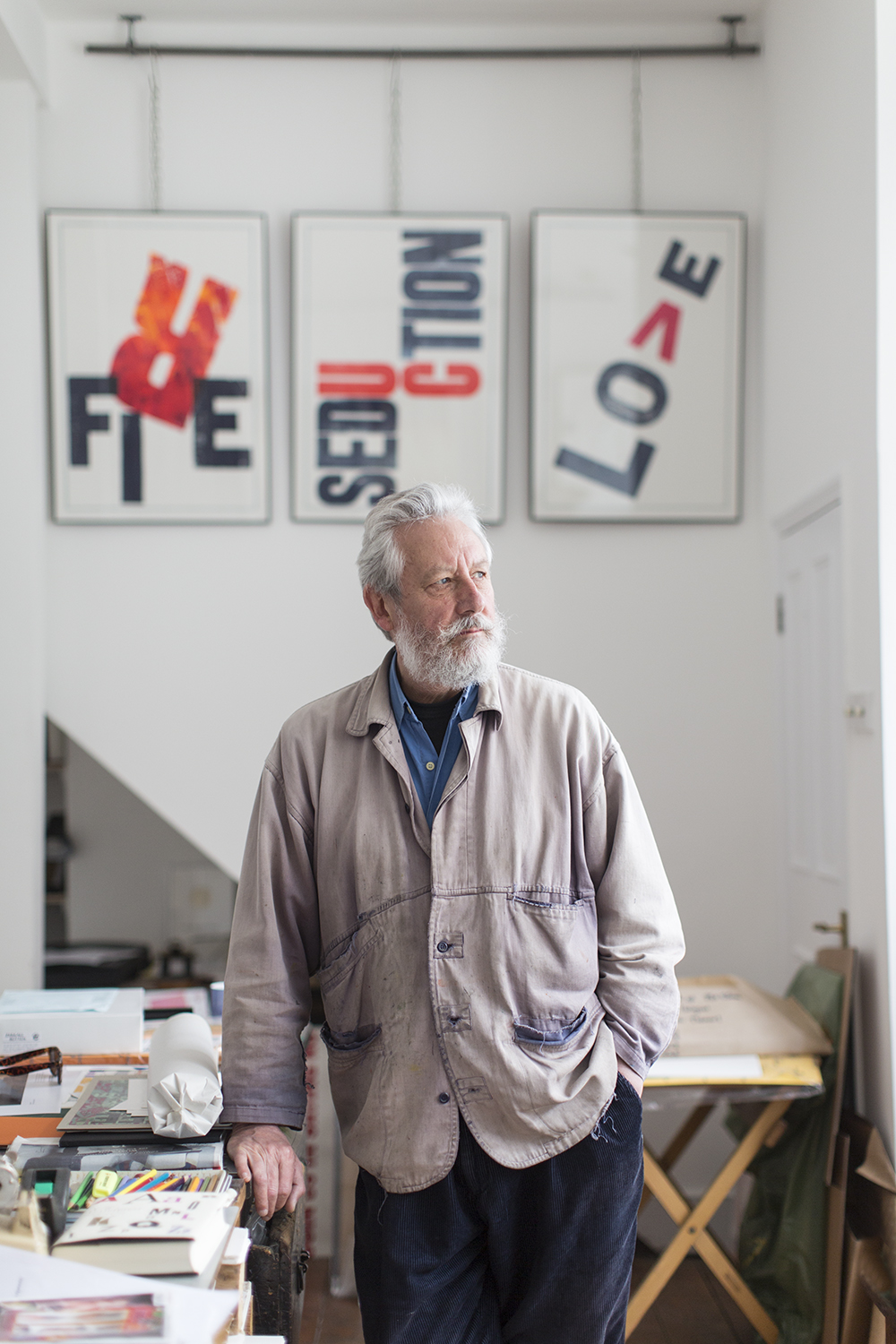
I set up my own shop and studio in Clerkenwell in 1989 and bought all the kit. A lot of work came out of it and I explored new ways of using type and the printing press. Even though all my clients, from Pentagram to Saatchi & Saatchi, have let me do what I want, I always ask what the article is about. It’s more than making nice, pretty images – there has to be some logic to it.
The Guardian is one of my favourite clients; I’ve worked with them intermittently over the years. One of the big jobs was an ad for the anti-war campaign in 2003. It was used in the paper and doubled as a banner at the rally. I had an exhibition at their new offices back in January too.
I met my late wife Celia in 1994 at the Chelsea Arts Club. She had a huge flat in Chelsea where we both lived, but she decided it wasn’t big enough for two people so we came here to Kennington, which I much prefer. She was a singer and wanted to do concerts here and, of course, it doubled as a studio for my printing things.
While Celia was still here, we bought a huge collection from a guy in a little village in Somerset who had two huge, medieval barns full of type. He said we had to take everything or nothing, so we went to the pub to have a think about it. I remember saying, “Do we want a pension, or do we want to buy this?” We decided on the latter and, as you can see, it is everywhere, all over the flat. I’m so pleased we bought it.
As far as health and fitness are concerned, I have a very boring routine of cooking the same things. I don’t vary my diet very much. I have a bike so I cycle to my other workshop, plus I work on my feet all day, so come four o’clock I’ve had it.
In a way, age is a setback – I haven’t got the energy I had at, say, 54. I am more aware of my limitations where that is concerned. I have a lot of young followers and students though, and get invited to go and talk all over the place, which I really enjoy. I’m very happy being 74; the only other age I’ve enjoyed as much was when my two sons were both young kids.
My plan from here is to keep doing more interesting work. I have a gallery – Advanced Graphics – where I sell my art and another big book coming out next year.
The most important lesson I’ve learnt? Do as you would be done by.