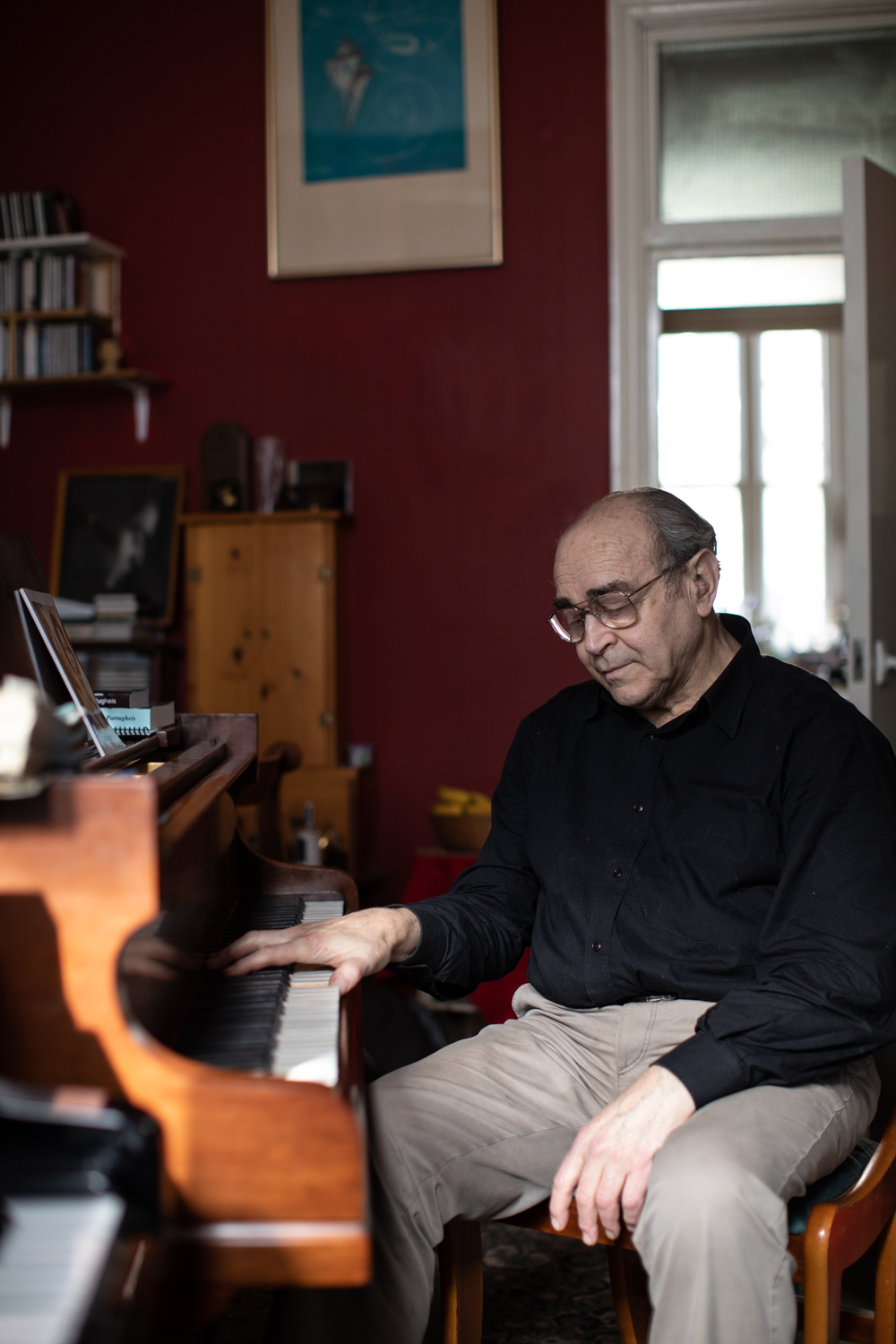
I discovered music thanks to our neighbours in Argentina. I would be on the street playing with my friends and the sound from their radio flowing through the window would stop me in my tracks. At school, my teacher said quite early on that I should be a professional musician. Eventually, she said she had taught me everything she knew, so I went off to Buenos Aires to study the piano.
In those days, being a boy and playing the piano was very unusual, and my father didn’t approve. His dream was that his son wouldn’t have to start from scratch like he did – he had worked hard to start a furniture shop and planned to pass it on to me. When I lived at home, we fought all the time because he wanted to watch TV when he came back from work and I had to practise for my lessons. He would turn the TV up louder and louder while I was trying to play. It was awful. I think he ended up being proud of me, but he never showed it.
When I was a child, I didn’t realise that music was a profession, particularly as my family weren’t involved in it. When I was about 11, I heard my first concert by a Russian pianist in my hometown, and I remember wondering what he did for a real job. It didn’t occur to me that he would be paid. Later on in life, when I met agents who represented artists, I realised it could be a career and I knew I wanted to dedicate my life to music.
I ended up in Europe because my university was offering an exchange programme with Germany. Before I left Germany, I decided to go and visit the grave of my favourite Romanian pianist in Geneva. While I was there, I found out that his widow was also a pianist. I managed to meet her and she ended up asking me to come to play with her in Geneva. I went back to Argentina and worked very hard to raise the funds to come back to Europe, and I set up in Geneva. It was there that I won first prize in a competition organised by the Conservatoire, which is really how I started my profession.
Today, with my experience, I can tell immediately if someone has a special talent. Talent is something that can’t be taught – it is not just a matter of playing perfectly. It is not even inherited; you can come from a very unmusical family and possess some kind of genius.
Playing the piano is very emotional – sometimes I cry when I play. You can’t separate the written text from emotions. The black stains you see on the paper are not the music; the music is what is in the head and heart of the composer. Most art is based in emotion. In music, you transmit that emotion through sounds, in painting you transmit it through colour and style, and in sculpture through form. If you go to the ballet, for example, you can tell who is a real artistic dancer and who is dancing perfectly, but acrobatically. You might as well go to the circus for that.
I do get nervous when I play – you have to learn how to control it. Experience is important, of course, but it’s also crucial to think about what is important in a performance. Is it the music, or is it you? If you put the music first, it helps. When you hear 20 pianists in a row in competitions and things, you can tell who is thinking of the music and who is thinking of themselves.
Regrets? I am sure I have some. We all make mistakes in life, but sometimes something good can happen from something that seems bad at the time. Life is a combination of good and bad – just as we have day and night and hot and cold and everything in between.
My life motto? Be honest with yourself and others.